Flowers in the Vase II and the Beauty of Seeing Things Differently
One of the things I enjoy most about painting is discovering how the same idea can lead somewhere completely different.
You might begin with a familiar subject, perhaps a pond, a landscape, or a vase of flowers. But once the colors and shapes begin finding their way onto the canvas, the result develops a personality of its own.
That's something I find especially interesting about my painting, Flowers in the Vase II.
This piece was created as a companion to my earlier painting, Flowers in Vase. Both explore colorful flowers reaching outward from a vase, yet each offers a different experience.
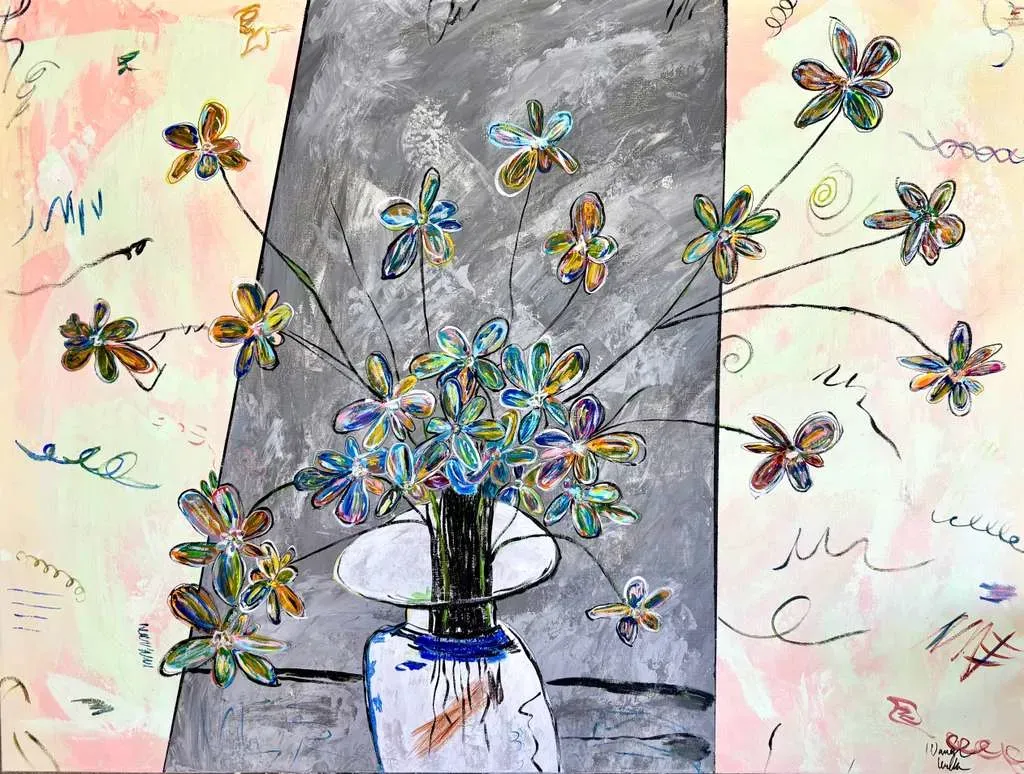
In Flowers in the Vase II, the composition opens into a wider arrangement. The flowers spread across a textured gray center and into softer areas of pink, cream, and pale yellow.
Their petals are filled with blues, greens, purples, and touches of orange. Meanwhile, long, delicate stems stretch in different directions, giving the painting a sense of movement.
Some blossoms gather close together. Others seem happy to find their own space.
I like that feeling.
There's something wonderfully natural about flowers that don't seem concerned with staying perfectly arranged.
And while this painting began as part of the same artistic idea as its companion, it eventually became something different.
That's part of the pleasure of creating abstract floral art. A familiar subject can keep offering new possibilities, even when you think you've already explored it.
Table of Contents
- Why I Returned to the Same Floral Subject
- Two Companion Paintings With Different Personalities
- A Closer Look at the Colors in Flowers in the Vase II
- The Movement That Makes This Painting Feel Alive
- The Importance of the Background and White Vase
- Finding Beauty in Imperfect Flowers
- The Small Details That Make Abstract Art Interesting
- How Flowers in the Vase II Found a New Home
- Why Floral Still Life Paintings Remain Meaningful
- Exploring More of My Original Artwork
- Frequently Asked Questions
Why I Returned to the Same Floral Subject
I've always found flowers interesting because they're both familiar and unpredictable.
Almost everyone has seen flowers sitting in a vase. We might place them on a table, bring them inside from a garden, or receive them from someone special.
Yet no two arrangements are quite alike.
Some stems stand tall, while others bend toward the edge of the vase. Certain flowers open completely, and others seem to be waiting for their moment.
Even the spaces between the flowers create interesting shapes.
When I look at a floral arrangement, I don't necessarily see something that needs to be copied exactly.
Instead, I see possibilities.
There are colors that might look interesting beside one another, lines that could move across the canvas, and shapes that can become more expressive as the painting develops.
One Subject Can Offer Endless Possibilities
I don't think returning to a familiar subject means repeating yourself.
In fact, the more time you spend observing something, the more details you may begin to notice.
A flower that first attracts you because of its color might become interesting for the shape of its petals.
A curved stem might suggest movement.
Even the empty space around a blossom can influence the way you experience the entire arrangement.
With Flowers in the Vase II, the familiar subject gave me another opportunity to explore those relationships.
The flowers remain recognizable, but the arrangement has a looser, more expansive quality.
And I think that makes it interesting in a different way from the original painting.
Two Companion Paintings With Different Personalities
One of the reasons I enjoy looking at these two paintings together is that they share something recognizable without appearing identical.
Both feature colorful flowers arranged around a vase.
Both use expressive lines and areas of contrasting color.
And both allow the flowers to extend beyond what might be expected from a more traditional still-life painting.
However, the overall experience is different.
Flowers in Vase: A More Vertical Arrangement
In the original Flowers in Vase, a tall white vase helps establish the center of the composition.
The flowers spread upward and outward, creating a sense of height and movement.
The gray background provides contrast, while the blue and turquoise petals give the arrangement much of its character.
There is a feeling of flowers reaching into the surrounding space.
Flowers in the Vase II: A Wider, More Open Composition
In the second painting, the flowers seem to have even more room to explore.
The white vase sits lower in the composition, while the blossoms spread outward across a broad arrangement of gray and pale-colored areas.
Some flowers gather around the center. Others appear farther away, almost as though they've wandered into their own little corners of the painting.
The stems create a network of lines that connect the different blossoms.
I enjoy how the painting allows your attention to move from one flower to another without following a strict pattern.
Although the subject remains familiar, the experience feels more open and spontaneous.
What Makes Each Painting Unique?
The differences between these two pieces remind me that a painting doesn't need an entirely new subject to become something new.
Sometimes a change in composition, color, or movement can create a completely different feeling.
That's what makes working with familiar natural subjects so rewarding.
There's always another way to see them.
You can explore the original Flowers in the Vase II painting and compare it with Flowers in Vase to see how the two compositions relate to one another.
A Closer Look at the Colors in Flowers in the Vase II
Color plays an important role in nearly everything I paint.
Sometimes I'm interested in strong contrasts. Other times, smaller variations between colors become the most fascinating part of a composition.
In Flowers in the Vase II, the flowers contain an especially lively combination of colors.
There are rich blues, bright greens, turquoise, purple, yellow, and small touches of warmer tones.
What I enjoy is how these colors appear together within individual flowers.
A single blossom might contain several different shades, each contributing something to its character.
When Blue and Yellow Come Together
Blue and yellow can create a particularly interesting contrast.
In this painting, darker blue outlines help define many of the petals, while yellow adds brightness and warmth.
Green and turquoise often appear between those colors, creating transitions that feel playful and energetic.
Some flowers have stronger yellow passages. Others seem to lean toward blue or purple.
Yet the colors work together across the composition.
I like the way those repeated shades help connect flowers that appear in different areas.
Even when two blossoms are separated by a large space, a familiar color can create a relationship between them.
The Softer Colors Around the Flowers
Another interesting part of this painting is the contrast between the flowers and their surroundings.
The central background contains broad gray areas, while the outer sections include softer pink, cream, and pale yellow tones.
Those quieter colors provide a different experience from the brighter petals.
They give the flowers space to stand out.
At the same time, they prevent the background from feeling completely empty.
There are delicate changes in color throughout the surrounding areas, along with expressive lines that add another layer of interest.
Sometimes the colors you notice last are just as important as the ones that first catch your attention.
The Movement That Makes This Painting Feel Alive
One thing I particularly enjoy about this painting is how the flowers seem to move through the composition.
Of course, nothing is actually moving.
But the long stems, open petals, and irregular positions of the blossoms create a feeling of activity.
Some flowers reach toward the upper corners.
Others lean toward the sides, while several gather close together near the vase.
Your eye can travel through the painting in many different directions.
The Beauty of Curved Stems
I've always found natural lines interesting.
A branch, a blade of grass, or the stem of a flower rarely follows a perfectly straight path.
Instead, it bends, changes direction, and responds to the world around it.
Those movements can create beautiful shapes.
In Flowers in the Vase II, the stems are especially noticeable because many extend across the quieter background.
Their dark, delicate lines provide contrast against the gray and pale-colored areas.
They also create connections between flowers that might otherwise feel separate.
I find that relationship fascinating.
The stems aren't simply there to hold up the blossoms. Visually, they're helping organize the entire painting.
Allowing the Flowers to Spread Naturally
One of the things I appreciate about nature is that it doesn't worry about perfect arrangements.
Flowers don't grow at equal distances from one another.
They don't all face the same direction.
And they certainly don't seem concerned about whether every part of a composition is balanced.
Yet the result can be beautiful.
I enjoy allowing some of that natural irregularity into my floral paintings.
Instead of making every flower fit neatly inside the arrangement, I like exploring how the shapes can move across the canvas.
That freedom gives each painting a different kind of energy.
The Importance of the Background and White Vase
Sometimes the most interesting parts of a painting aren't the things you notice first.
In this piece, the colorful flowers immediately attract attention.
However, the background and vase play an important role in how the entire composition comes together.
Why the Gray Center Works So Well
The large gray area behind the flowers creates a strong visual foundation.
Its surface contains different shades and expressive marks, so it doesn't appear completely smooth or uniform.
Meanwhile, the darker gray tones help the colorful petals become more noticeable.
I like that contrast.
The flowers can remain lively and expressive without the background competing with every detail.
At the same time, the surrounding pale areas introduce lightness into the composition.
This creates an interesting relationship between the darker center and the softer edges.
The White Vase as a Point of Connection
The vase sits near the lower center of the painting.
It appears mostly white, with dark marks and smaller areas of blue and warmer color.
Although the vase is relatively simple compared with the flowers, it gives the arrangement somewhere to begin.
The stems gather toward its opening before spreading outward.
Without that recognizable shape, the composition might feel like a collection of flowers floating independently across the canvas.
The vase connects them.
A Simple Object Can Hold an Expressive Composition Together
That's something I find interesting about still-life painting.
A familiar object, such as a vase, can provide structure while allowing the surrounding elements to become more expressive.
In this case, the white vase offers a relatively quiet shape beneath the colorful flowers.
It anchors the composition without taking away the flowers' personality.
And sometimes that's exactly what a painting needs.
Finding Beauty in Imperfect Flowers
I don't believe flowers need to look perfect to be beautiful.
In fact, some of the most interesting flowers I've noticed have unusual shapes or unexpected colors.
One petal might be wider than the others.
A blossom may lean awkwardly to one side.
Sometimes a flower is partly hidden behind another, making it difficult to see its complete shape.
Yet those differences give an arrangement its character.
Why Abstract Floral Art Doesn't Need Perfect Symmetry
In a realistic painting, an artist may carefully reproduce every curve and shadow.
That's a wonderful approach, but it isn't the only way to explore flowers.
With abstract floral art, there's more freedom to emphasize color, shape, and feeling.
A petal can become a broad mark of blue.
A small touch of yellow can suggest the center of a blossom.
A few dark lines can give a flower its identity without defining every detail.
I enjoy that freedom.
It allows the flowers to remain recognizable while becoming part of a larger arrangement of color and movement.
Every Flower Has a Different Character
If you look closely at Flowers in the Vase II, you'll notice that the blossoms don't all have exactly the same appearance.
Some have broad petals with several overlapping colors.
Others are smaller and more delicate.
There are flowers with strong blue outlines and others with brighter yellow or green passages.
I like how these differences keep the painting interesting.
Instead of seeing one repeated shape, you discover a collection of individual forms.
Each seems to have found its own place.
And I think that's part of what gives the arrangement such a lively feeling.
The Small Details That Make Abstract Art Interesting
One of my favorite things about sharing paintings is hearing what different people notice.
Someone may be drawn immediately to a particular color.
Another person might focus on the overall arrangement.
And occasionally, someone points out a small detail that I hadn't expected to attract attention.
I enjoy those conversations because they remind me that everyone experiences artwork differently.
Look Beyond the Flowers
In Flowers in the Vase II, there are plenty of details beyond the main blossoms.
Look at the pale areas on either side of the gray background.
You'll notice small curved lines, marks, and touches of color that don't necessarily represent anything specific.
Some appear almost like little sketches or gestures.
Others provide unexpected moments of movement within otherwise quiet spaces.
I think those marks give the painting a wonderful sense of spontaneity.
They also reward a closer look.
Why I Like Leaving Room for Discovery
When someone looks at a painting for the first time, they usually notice the overall composition.
But after spending more time with it, smaller details begin to appear.
Perhaps it's a color combination inside one flower.
Maybe it's the way two stems cross or how a dark line contrasts with the background.
These discoveries can change how you experience a painting.
I often think about how my own relationship with a painting develops while I'm working on it.
As I've discussed in Learning to Trust the Painting, the creative process doesn't always move in a predictable direction.
Sometimes a painting takes time to reveal what it needs.
And I like the idea that viewers can experience something similar when looking at the finished work.
Seeing the Artwork Beyond a Screen
Photographs allow me to share paintings with people who may live far away.
However, experiencing an original painting in person can reveal qualities that aren't always obvious in an image.
The surface, scale, color relationships, and smaller marks can become more noticeable.
I work primarily with acrylic paint and palette knives, and the physical character of the paint is an important part of my artistic approach.
When looking at original artwork, I encourage people to notice not only the subject but also the marks that give the surface its personality.
Sometimes the smallest detail becomes the reason someone remembers a painting.
How Flowers in the Vase II Found a New Home
This painting also became part of a particularly meaningful moment in my journey as an artist.
Flowers in the Vase II and its companion, Flowers in Vase, were purchased together by a collector in California.
Knowing that someone wanted both paintings was a wonderful experience.
These two pieces began as related works, each exploring a familiar subject in a different way.
Then, unexpectedly, their stories came together again when someone decided they belonged in the same home.
I find that connection especially meaningful.
Two Paintings, One Collector
When I create a painting, I'm usually thinking about the work in front of me.
I'm exploring the colors, composition, and possibilities that develop on the canvas.
I don't know where the finished painting might eventually go or who might connect with it.
That's one of the unexpected parts of sharing artwork.
With these two paintings, the connection was particularly special because someone responded to both pieces.
Although the paintings have different personalities, they clearly had something that appealed to the same collector.
I like imagining how two related works might be experienced together.
Of course, I don't know exactly how they're displayed or what details their owner appreciates most.
But knowing that both paintings became part of someone's home means a great deal.
A Meaningful Moment in My Artistic Journey
For a long time, I had wondered whether my paintings would connect with people beyond the friends and family who had encouraged me.
Their support was important.
But discovering that someone unfamiliar with my work could see something meaningful in it was a different kind of experience.
The purchase of these companion paintings helped me realize that my artwork could reach people well beyond my immediate circle.
That's something I continue to appreciate.
I've written about the feeling of sharing art in When My Paintings Find a Home.
Knowing that something created in my studio can become part of another person's daily life is one of the most rewarding aspects of painting.
And these two paintings will always remind me of that.
Why Floral Still Life Paintings Remain Meaningful
Flowers have been subjects of artwork for centuries.
Artists have painted them in gardens, fields, and carefully arranged bouquets.
There's a long tradition of floral still-life painting, and I find it interesting that such a familiar subject continues to offer opportunities for personal expression.
The Museum of Modern Art's explanation of still life describes the genre as the representation of natural or manufactured objects in arrangements chosen by an artist.
It's a simple idea, but the possibilities are almost endless.
A Familiar Subject With Personal Meaning
Flowers can remind us of different things.
Perhaps you remember a garden from childhood.
Maybe certain colors bring back the feeling of spring or a particular place.
Sometimes flowers are connected with special occasions, while at other times we simply enjoy having them nearby.
I don't think a painting needs to communicate the same memory to everyone.
In fact, I enjoy the thought that people may connect with my work for reasons entirely different from my own.
An abstract flower painting can offer familiar shapes while leaving room for personal interpretation.
And that's one of the qualities I appreciate most about art.
The Pleasure of Living With Original Art
I also think there's something special about having an original painting in your home.
It becomes part of your surroundings.
You may walk past it every day, but occasionally a particular color or detail catches your attention in a different way.
Perhaps the light has changed.
Or maybe you're simply noticing something you hadn't seen before.
Those small moments can make living with art enjoyable.
For me, the greatest reward isn't necessarily that someone understands every choice I made while painting.
It's that the finished work brings them something meaningful.
That might be a little happiness, a memory, or simply the pleasure of looking at colors they enjoy.
Exploring More of My Original Artwork
Although Flowers in the Vase II has already been sold, I'm happy that its story remains part of my website.
The painting represents my continuing interest in flowers, color, expressive lines, and the freedom to explore a familiar subject in different ways.
If you'd like to see the complete artwork, you can visit the Flowers in the Vase II painting page.
You're also welcome to explore my collection of original abstract paintings.
Some paintings focus on flowers arranged in vases, while others explore water lilies, grasses, natural landscapes, and the colors that catch my attention.
Each piece develops its own personality.
And I hope you'll find something that makes you want to look a little longer.
Interested in Purchasing a Similar Abstract Floral Painting?
If you enjoy the colors, movement, and expressive qualities of Flowers in the Vase II, I invite you to explore my other original floral paintings.
Although this particular painting is no longer available, other artworks may be available for purchase.
You can browse my paintings gallery and contact me with questions about a piece that interests you.
For availability, pricing, or purchasing inquiries, please email me at info@wwabstract.com.
I'm always happy to hear from people who enjoy my work, whether they're interested in collecting a painting or simply want to share what they see.
Final Thoughts: Finding Something New in a Familiar Idea
Looking at Flowers in the Vase II reminds me that creativity doesn't always require beginning with something completely new.
Sometimes a familiar subject can lead to an entirely different experience.
The flowers, vase, and flowing stems connect this painting with its companion.
Yet the wider arrangement, softer surrounding colors, and individual blossoms give it a personality of its own.
I find that interesting.
Two paintings can share the same basic idea without telling exactly the same visual story.
And perhaps there's something meaningful in that beyond painting itself.
We can return to familiar places, objects, or experiences and still discover details we never noticed before.
That's one of the reasons I continue to enjoy painting.
There's always another color to explore, another shape to discover, or another idea waiting to develop.
I'm especially grateful that Flowers in the Vase II and its companion found a home together.
Their journey reminded me that art can connect people through something as simple as a shared appreciation for color and beauty.
Thank you for taking the time to explore this painting.
I hope you'll continue looking through my work and discover something that speaks to you.
Warren
Frequently Asked Questions
1. What is Flowers in the Vase II by Warren Wulkan?
Flowers in the Vase II is an original abstract floral painting by Warren Wulkan. It features colorful blue, yellow, purple, and green flowers extending from a white vase against a textured gray and pastel background. The painting emphasizes expressive movement, color, and individual floral shapes.
2. What is the difference between Flowers in Vase and Flowers in the Vase II?
The paintings are companion pieces that explore the same floral subject in different ways. Flowers in Vase has a more vertical arrangement, while Flowers in the Vase II features a wider composition with flowers spreading across the canvas. Both share expressive colors and lines but have distinct personalities.
3. What materials were used to create Flowers in the Vase II?
The official artwork listing identifies Flowers in the Vase II as acrylic on canvas, with dimensions listed as 30 × 40. Warren primarily works with acrylic paint and palette knives to explore color, movement, and texture.
4. Is Flowers in the Vase II available for purchase?
No. The original Flowers in the Vase II has been sold. It was purchased together with its companion painting by a collector in California. However, other original paintings may be available through Warren Wulkan's artwork gallery.
5. Why does Warren Wulkan paint flowers in vases?
Flowers offer endless possibilities for exploring color, line, shape, and movement. Warren's floral paintings reflect his broader interest in nature and expressive artwork, allowing familiar subjects to develop their own character on canvas.
6. What makes Flowers in the Vase II an abstract floral painting?
The artwork combines recognizable flowers and a vase with colorful, expressive petals, curved stems, simplified shapes, and spontaneous marks. Rather than reproducing every detail realistically, the painting emphasizes the visual relationships between colors and forms.
7. Can I purchase a similar original abstract flower painting?
You can inquire about other original floral paintings by visiting the paintings collection. For current availability, dimensions, and purchasing details, contact Warren directly at info@wwabstract.com.
8. Where can I view the original Flowers in the Vase II artwork?
You can view the painting and read its official description on the Flowers in the Vase II artwork page. Although the painting has sold, its image and details remain available to visitors.