An Abstract Floral Painting With a Life of Its Own
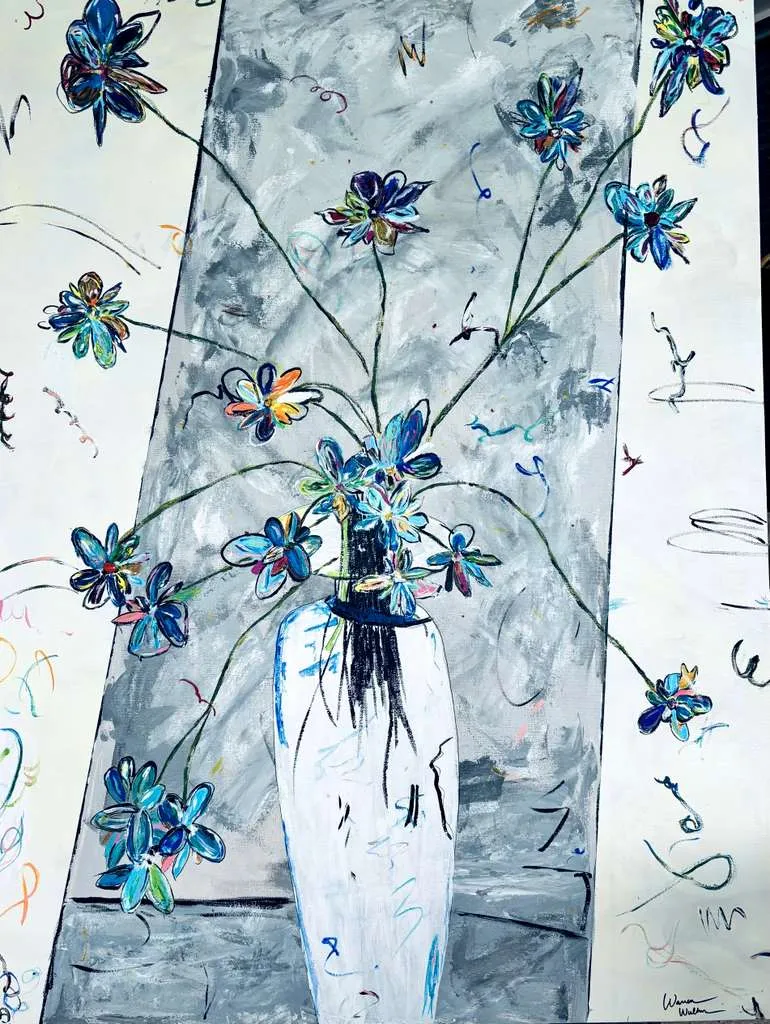
There's something about flowers in a vase that I've always found interesting.
We bring them indoors, place them in a container, and perhaps try to arrange them in a way that looks just right. But flowers have a wonderful habit of doing their own thing. One stem leans to the side, another reaches upward, and before long, the arrangement has a personality all its own.
I think that's part of what makes them so beautiful.
My painting, Flowers in Vase, explores that feeling through color, movement, and an approach that leaves plenty of room for the unexpected.
At first, you might notice the tall white vase standing against a soft gray background. But look a little longer, and the flowers begin taking over. Their blue, purple, and turquoise petals spread in different directions, while long, delicate stems reach across the canvas.
Some flowers seem to float beyond the central background. Others gather closer to the vase, creating a composition that feels both organized and wonderfully unpredictable.
That's what I enjoy about creating an abstract floral painting. I can begin with something familiar from everyday life, yet allow the colors and shapes to develop in their own way.
And this particular painting became meaningful to me for reasons that went well beyond the canvas.
Table of Contents
- The Simple Beauty of Flowers in a Vase
- Why I Love the Freedom of Abstract Floral Art
- A Closer Look at the Colors in Flowers in Vase
- The Quiet Importance of the White Vase
- Finding Movement in Every Stem and Petal
- Why the Small Marks Matter
- The Unexpected Story Behind Flowers in Vase
- What This Painting Taught Me About Sharing My Art
- How Abstract Flower Paintings Connect With People
- Explore Flowers in Vase and My Other Paintings
- Frequently Asked Questions
The Simple Beauty of Flowers in a Vase
Flowers are such a familiar part of our lives that it's easy to overlook how interesting they really are.
We see them growing outside, arranged on tables, or sitting in a vase near a window. Sometimes they're bright and colorful. Other times, their beauty comes from the smallest differences in shape or color.
But the more closely I look at flowers, the more I notice that no two arrangements are quite the same.
Even when the flowers are similar, their stems bend differently. Their petals open at different angles, and the spaces between them create patterns that are just as interesting as the flowers themselves.
I find those little differences fascinating.
Finding Inspiration in Ordinary Things
I've always been drawn to subjects from nature.
Water lilies, marsh grasses, flowers, and quiet landscapes often find their way into my paintings. However, what interests me isn't necessarily creating an exact picture of what I see.
I'm more interested in the feeling a subject creates.
A vase of flowers might seem like a simple thing to paint, but there are countless possibilities hidden within it.
You can explore the relationship between the vase and the flowers, the contrast between light and dark, or the movement created by stems reaching in different directions.
In Flowers in Vase, those elements come together in a composition that feels familiar without being completely traditional.
The flowers are recognizable, but their shapes, colors, and positions allow the painting to become something more expressive.
Why I Love the Freedom of Abstract Floral Art
One of the things I enjoy most about painting is not having to reproduce everything exactly as it appears.
I admire realistic paintings and the skill required to create them. However, when I work on abstract art, I'm interested in exploring possibilities that might not exist in a photograph.
A flower doesn't always need a perfectly defined petal. A stem can become a sweeping line, and a familiar arrangement can develop into something unexpected.
That freedom is exciting.
Letting the Flowers Have Their Own Personality
Look at the flowers in this painting.
Some appear to be reaching toward the top of the canvas. Others lean outward, while a few smaller blossoms sit closer to the vase.
The arrangement isn't perfectly symmetrical.
And I like that.
There's something natural about flowers growing in different directions, even when they've been gathered into a vase.
In this painting, that irregularity gives the composition its character.
The flowers don't seem to be following a carefully planned pattern. Instead, their movement encourages your eye to travel from one part of the canvas to another.
When Familiar Shapes Become Abstract
What I find interesting about abstract floral artwork is that it can remain recognizable without depending on precise details.
You don't need to see every petal realistically painted to understand that you're looking at flowers.
Sometimes a few expressive marks and carefully placed colors are enough.
Artists have explored this freedom with still-life subjects in many different ways. For example, the Metropolitan Museum of Art's Vase of Flowers by Preston Dickinson shows how a familiar arrangement can become an opportunity to experiment with composition and perspective.
I appreciate that idea.
A simple vase of flowers can be a starting point rather than a set of rules.
And once you allow yourself that freedom, the possibilities begin to open up.
H2: A Closer Look at the Colors in Flowers in Vase
Color is usually one of the first things that attracts me to a painting.
Sometimes it's a strong contrast between two colors. Other times, it's a small unexpected touch that changes the feeling of the entire composition.
In Flowers in Vase, the flowers contain some of my favorite combinations.
Deep blues sit beside turquoise and green. Purple appears among the petals, while little touches of orange and warmer colors add contrast.
These colors give the flowers a lively appearance against the quieter background.
Blue and Turquoise Bring the Flowers to Life
Blue is particularly noticeable throughout this painting.
Some petals contain dark, almost navy-colored passages, while others move toward brighter turquoise tones.
The variation helps distinguish the flowers from one another.
However, it also creates a connection between them.
Even though the blossoms appear in different areas of the canvas, the repeated blues help bring the composition together.
I enjoy how those colors can feel both calming and energetic.
A darker blue may seem quiet, while a brighter turquoise can immediately attract your attention.
Together, they give the painting a changing rhythm.
The Small Touches of Unexpected Color
If you look more closely, you'll notice that the flowers aren't made entirely of blue.
There are small areas of orange, pink, purple, and green mixed among the petals.
Some of these colors are easy to overlook at first.
Yet they make a difference.
A touch of orange beside turquoise can make both colors appear more vibrant. A darker purple can add depth, while a little green helps connect the blossoms to their stems.
I find it amazing how a small mark of color can change the character of an entire flower.
Sometimes those unexpected combinations become the details I appreciate most.
The Quiet Importance of the White Vase
Although the flowers create much of the movement, the vase plays an equally important role.
It stands near the center of the painting, tall and mostly white, with dark expressive marks running through parts of its surface.
Compared with the colorful blossoms, the vase has a much quieter appearance.
And that contrast is important.
A Simple Shape That Holds Everything Together
The vase gives the composition a place to begin.
Its shape is recognizable, even though its surface contains loose lines and irregular marks.
The flowers spread outward from it, creating a relationship between something relatively stable and something much more energetic.
I like that difference.
Without the vase, the flowers might seem to be floating independently across the canvas.
With it, they become part of a single arrangement.
Why the Gray Background Matters
Behind the vase and many of the flowers is a broad area of soft gray.
At first, it might seem less interesting than the colorful blossoms.
However, the gray creates a kind of visual breathing room.
It allows the blues and turquoise colors to stand out without competing with another bright background.
At the same time, the surrounding white areas keep the composition feeling open.
There is a balance between the quiet parts of the painting and the areas filled with movement.
For me, that relationship makes the flowers even more interesting.
Sometimes a painting needs a little space to allow its most expressive details to be appreciated.
Finding Movement in Every Stem and Petal
One of the things that stands out to me in this painting is the movement created by the stems.
They're long, thin, and curved, stretching outward from the vase in several directions.
Some rise toward the upper corners. Others reach across the middle or bend toward the lower edges.
These lines create a sense of energy throughout the painting.
The Beauty of Natural Movement
Flowers rarely grow in perfectly straight lines.
They bend toward sunlight, lean under their own weight, and sometimes twist into unexpected shapes.
Even when placed in a vase, they retain something of that natural movement.
In this painting, the curved stems help create that feeling.
Rather than keeping all the flowers gathered tightly in one place, the lines allow them to spread across the canvas.
The arrangement becomes more open and expressive.
Following the Lines Through the Painting
I enjoy the idea that someone can begin looking at one flower and gradually discover another.
Your eye might follow a stem from the vase toward a blossom near the upper edge.
Then perhaps you'll notice another line moving across the gray background.
Before long, you're exploring details that weren't immediately obvious.
That's one of the pleasures of looking at abstract art.
You don't necessarily have to follow a single path.
The composition gives you different places to begin, and each visit can reveal something new.
Why the Small Marks Matter
If you've looked at my other paintings, you may have noticed that I don't always try to hide every mark made during the painting process.
I work primarily with acrylic paint and palette knives, exploring the possibilities of color, texture, and movement.
Sometimes a mark becomes important precisely because it doesn't look perfectly controlled.
That quality is part of what attracts me to expressive painting.
The Lines That Give the Painting Character
Throughout Flowers in Vase, there are small lines, curves, and irregular marks.
Some appear near the flowers, while others sit within the gray and white areas.
They don't all represent a recognizable object.
Instead, they add movement and personality to the composition.
I like how these details prevent the painting from feeling too carefully arranged.
They remind me that making art involves experimentation.
Not every mark has to describe something specific.
Sometimes it simply needs to belong.
The Difference Between Seeing and Looking Closely
From a distance, you might see a white vase holding colorful flowers.
Move closer, and the painting begins to change.
You notice individual lines along the vase, small areas of color within the petals, and unexpected marks between the flowers.
The composition becomes more complicated, but also more interesting.
Details That Reward a Second Look
I think some paintings offer their greatest pleasures slowly.
You may enjoy the overall colors immediately. However, after spending more time with the artwork, a smaller detail might begin to catch your attention.
Perhaps it's a single flower near the edge or an unusual combination of colors inside one petal.
Those little discoveries make looking at original art a personal experience.
And I hope they encourage people to spend a little longer with my work.
The Unexpected Story Behind Flowers in Vase
Of course, this particular painting has another meaning for me.
Shortly after I uploaded Flowers in Vase and its companion painting to my website, something wonderful happened.
A collector in California purchased both pieces.
It was an important moment in my journey as an artist.
Until then, I had quietly wondered whether my paintings would connect with people beyond the friends and family who had encouraged me from the beginning.
I appreciated their support tremendously.
But sharing something you've created with people who don't know you personally is a different experience.
You hope someone might see something meaningful in your work, yet you can never be completely certain how it will be received.
When these two paintings were purchased, that uncertainty began to change.
When My Artwork Reached Someone New
What made the experience so meaningful wasn't simply that the paintings had sold.
It was knowing that someone across the country had discovered my work and connected with it enough to want both paintings in their home.
These were people outside my immediate circle.
They hadn't been following every step of my artistic journey.
They encountered the artwork and made their own decision about what it meant to them.
That was an extraordinary feeling.
The paintings had begun as personal creative expressions. Now they were becoming part of someone else's everyday surroundings.
A Small Moment That Meant a Great Deal
I've often thought about what happens when a painting leaves the studio.
Something I spent time creating becomes part of a home I've never seen.
It may hang in a living room, hallway, or some other special place. Someone may walk past it every day and notice a different color or detail.
I don't know exactly how the collector experiences these paintings, and that's part of what makes the idea so interesting.
The artwork begins with my perspective, but it doesn't have to end there.
That California purchase gave me a stronger sense that my work could travel beyond the places and people I already knew.
And it encouraged me to continue sharing what I create.
You can see the original artwork and read its official description on my Flowers in Vase painting page.
What This Painting Taught Me About Sharing My Art
Painting is a deeply personal experience for me.
Long before anyone sees the finished work, there are decisions about color, shape, and composition.
There are also moments of uncertainty.
Sometimes I have an idea in my mind, but getting that idea onto the canvas isn't as straightforward as I expected.
Other times, an unexpected mark leads the painting in a new direction.
I've written about those experiences in Learning to Trust the Painting.
The process can be challenging, but I find it rewarding.
A Painting Can Become More Than I Intended
What continues to surprise me is how much a painting can mean to someone else.
I may be thinking about the relationship between the flowers and the vase, the colors, or the movement of the stems.
But someone looking at the finished work might connect with something entirely different.
Perhaps the flowers remind them of a favorite garden.
Maybe the colors bring back a memory.
Or perhaps they simply enjoy the painting without needing a particular reason.
I think that's wonderful.
A painting doesn't need to communicate exactly the same thing to everyone.
In fact, I enjoy the possibility that people may discover something I hadn't consciously considered.
Why Those Connections Encourage Me to Keep Painting
The experience with Flowers in Vase reminded me that sharing art involves a little trust.
You create something personal, put it into the world, and allow others to respond in their own way.
Sometimes that response is a thoughtful comment.
Other times, someone asks about a particular technique or tells you how a painting makes them feel.
And occasionally, a person decides that the artwork belongs in their home.
I've shared more about that feeling in When My Paintings Find a Home.
It remains one of the most rewarding parts of creating art.
How Abstract Flower Paintings Connect With People
One of the reasons I enjoy painting flowers is that they're familiar to almost everyone.
You don't need to know anything about painting techniques or art history to recognize a vase of flowers.
But an abstract interpretation leaves room for something more personal.
Everyone Notices Something Different
Some people may be drawn immediately to the blue and turquoise flowers in Flowers in Vase.
Others might notice the tall white vase, the unusual gray background, or the long stems reaching across the painting.
Someone else may find the small marks and irregular lines most interesting.
I don't believe there's one correct way to experience the artwork.
If you enjoy the colors, that's enough.
If it brings back a memory, that's wonderful too.
And if you're simply curious about how the painting was created, I always appreciate that kind of interest.
Art Can Bring Everyday Enjoyment
I sometimes think we place too much pressure on art to have a complicated explanation.
Of course, some paintings explore important ideas and complex subjects.
But art can also bring a little enjoyment into an ordinary day.
A painting might make a room feel warmer or more interesting. It may offer something beautiful to look at while you're having your morning coffee.
Perhaps you notice a new detail after living with it for several months.
Those moments matter to me.
If one of my paintings can bring someone a little happiness, curiosity, or calm, I consider that a meaningful connection.
Explore Flowers in Vase and My Other Paintings
Although the original Flowers in Vase has already been sold, I'm grateful that it found a home with someone who connected with the work.
The painting remains part of my artistic journey, and I'm happy to share its story with visitors to my website.
If you're interested in seeing more of the details, colors, and composition, you can explore the original Flowers in Vase acrylic painting.
I also continue to create and share original abstract paintings inspired by flowers, nature, water, and the places that capture my attention.
Each painting develops its own character.
Some are filled with strong color and movement. Others are quieter, allowing texture and smaller details to become more noticeable.
If this style of artwork interests you, please take a look through my collection of original abstract paintings.
You may discover another piece that speaks to you.
Interested in Purchasing an Original Painting?
If you enjoy Flowers in Vase and would like to purchase a similar original floral painting, I'd be happy to hear from you.
Because the original artwork has sold, I invite you to explore my other paintings and ask about current availability.
You can contact me directly at info@wwabstract.com with questions about purchasing artwork, available paintings, dimensions, or anything else you'd like to know.
I welcome your questions and comments, even if you're simply curious about a particular painting.
Sometimes the best conversations begin with someone telling me what they noticed.
Final Thoughts: A Simple Painting With a Meaningful Story
When I look back at Flowers in Vase, I'm reminded of two things I enjoy about being an artist.
The first is the freedom to take something familiar and explore it in my own way.
A simple vase of flowers can become a study of color, movement, and unexpected shapes.
The second is the wonderful experience of sharing that work with others.
I never know exactly how someone will respond to a painting.
But knowing that this piece and its companion found their way to a collector across the country gave me a new sense of encouragement.
It reminded me that art can create connections between people who may never otherwise meet.
And that possibility continues to mean a great deal to me.
Thank you for taking the time to look at my artwork and read its story.
I hope you'll explore more of my paintings and let me know what catches your attention.
Warren
Frequently Asked Questions
1. What is Flowers in Vase by Warren Wulkan?
Flowers in Vase is an original abstract floral painting by Warren Wulkan. It features colorful blue, turquoise, and purple flowers extending from a tall white vase against a soft gray background. The artwork combines recognizable floral shapes with expressive lines and movement.
2. What materials were used to create Flowers in Vase?
The artwork is listed as acrylic on canvas. Warren generally works with acrylic paint and palette knives, exploring color, texture, and expressive marks. The painting's official listing identifies its dimensions as 30 × 40 without specifying the units.
3. Is Flowers in Vase available for purchase?
No. The original Flowers in Vase painting has been sold to a collector in California. However, you can explore Warren Wulkan's painting collection and inquire about other original floral artworks that may be available.
4. Can I buy a similar abstract flower painting from Warren Wulkan?
Yes, you can inquire about other original floral paintings. Browse the gallery and contact Warren at info@wwabstract.com to ask about current availability and purchasing details.
5. What makes Flowers in Vase an abstract floral painting?
The painting features recognizable flowers and a vase, but it also uses expressive colors, simplified shapes, curved stems, and irregular marks. Rather than focusing entirely on realism, the composition emphasizes movement, color relationships, and personal interpretation.
6. What is the story behind Flowers in Vase?
Shortly after Warren uploaded Flowers in Vase and a companion painting, both were purchased by a collector in California. This became a meaningful moment in his artistic journey because it showed that his work could connect with people beyond his existing circle of friends and family.
7. Where can I view more original artwork by Warren Wulkan?
You can visit wwabstract.com/paintings to explore Warren Wulkan's collection of original abstract paintings, including floral compositions, nature-inspired works, water lilies, and textured acrylic artwork.